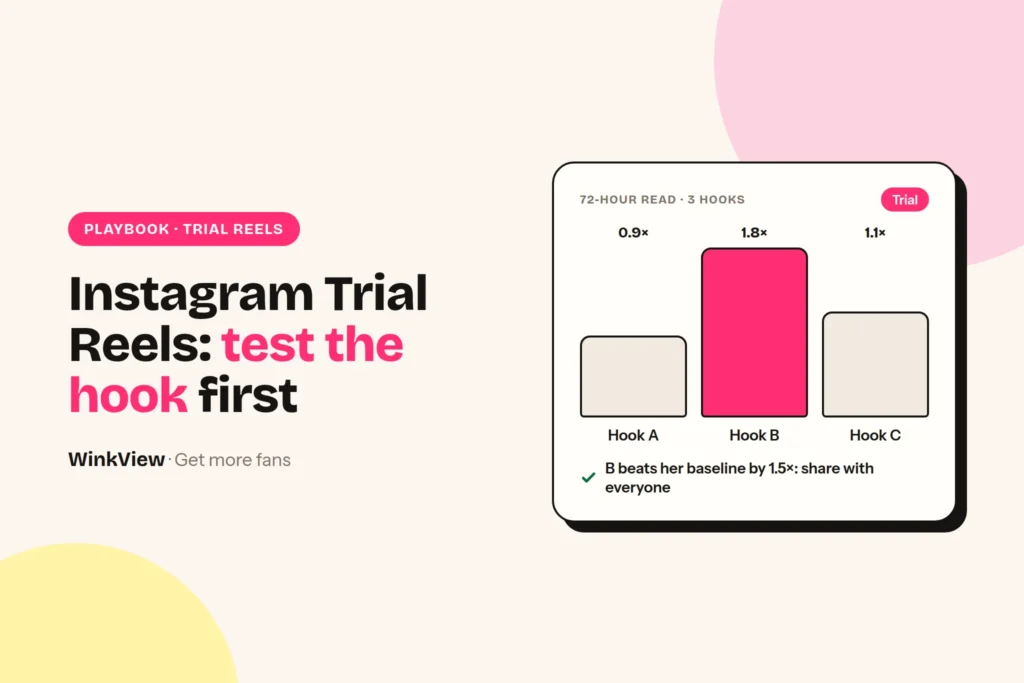
Instagram Trial Reels are Reels shown to people who do not follow the account first, so a creator can see how a clip performs with strangers before her followers or her profile grid ever see it. For an OnlyFans agency that makes them two things: a hook-testing lab, and a daily way to put every creator in front of new people. Below you get the verified facts, a weekly test protocol with a clear winner rule, a copyable test log, and how to automate Trial Reels across many creators so the habit does not depend on someone remembering a toggle.
The short answer
- A Trial Reel goes to non-followers first. It does not appear in followers’ feeds, the Reels tab or the profile grid unless you share it.
- You turn it on with the “Trial” toggle before sharing a reel. If the toggle is missing, the account is not eligible yet.
- About 24 hours after posting you see views, likes, comments and shares. You can let Instagram share it with followers automatically if it performs well on views in the first 72 hours.
- Testing method: one clip, three hooks, three Trial Reels a week, manual sharing only. Judge at 72 hours, promote only a variant that clearly beats the creator’s own trial baseline.
- Automation: software on Meta’s official API can post trials. WinkView posts about 3 videos a day per creator, 1 or 2 of them as Trial Reels, and reposts best performers as Trial Reels now and then.
- Trial Reels are free. The real cost is team time, or the tool that saves it.
Disclosure
We make WinkView, whose Reposting Agent posts Trial Reels as part of a creator’s daily schedule. The Trial Reels facts on this page come from Instagram’s and Meta’s own pages, linked in each section. Facts and prices checked 30 September 2026. Instagram changes features often, so check the app before you build a process on any single detail.
What Instagram Trial Reels are: the verified facts
Instagram announced Trial Reels on 10 December 2024 on its Instagram for Creators blog and in Meta’s newsroom, as a way to “try content with non-followers first”. Its Help Center page on Trial Reels describes them as a way to share reels with, and get feedback from, people who do not follow you. Here is what those official pages say, and nothing more.
| Question | What Instagram says |
|---|---|
| Who sees it first | People who do not follow the account. |
| Do followers see it | Not in their feed or the Reels tab unless you share it. They can still come across it through a DM, or on a page for the same audio, location or filter. |
| Profile grid | Not on the grid or the Reels tab unless shared. It sits in your profile next to drafts, and only you see the trial label. |
| How to turn it on | Create a reel as normal, then tap the “Trial” toggle before sharing. |
| Auto-share | Optional. Instagram shares it with followers automatically if it judges it is performing well based on views in the first 72 hours. You can change this setting later. |
| Manual share | Tap “share with everyone” to show it to followers and across Instagram. |
| Metrics | About 24 hours after posting: views, likes, comments and shares, plus a comparison with your previous trials. |
| Can software post one | Yes. Meta’s publishing API has a trial setting for Reels (see below). |
Tools that publish through Meta’s official API can post a Trial Reel too. Meta’s Instagram media publishing reference lists a trial setting for Reels with two options: manual, where you share the trial yourself in the app, or automatic sharing if the trial performs well. Publishing through the API needs a professional account. Neither official page publishes a daily cap on the number of Trial Reels, so we do not quote one.
Two rules from Instagram’s recommendation tips for creators matter more for OnlyFans teams than anything else on this page, because non-followers only see a trial if Instagram is willing to recommend it:
- Suggestive content is not recommended. Instagram names “content that may be sexually explicit or suggestive, such as pictures of people in see-through clothing”. A trial of a clip like that goes nowhere, however good the hook.
- Reuploads lose reach. The same page says “Avoid reuploading reels that are already on Instagram”. Keep that in mind when you give a strong clip a second run (more on that in the automation section).
How to use Trial Reels: eligibility and setup
Eligibility has changed since launch. The December 2024 announcement said “eligible creators” and pointed to the Help Center without listing the criteria. In July 2025 access widened, and trade press and social media consultants reported the bar as a public professional account with at least 1,000 followers. We could not confirm that exact bar on a page Instagram publishes, so treat it as reported, not official.
The practical test is quicker than any article: open the reel composer on the creator’s account and look for the Trial toggle. If it is there, she is eligible. If not, switch the account to a public professional account and keep posting normal Reels until it appears.
Setup for one Trial Reel takes under a minute:
- Start a reel as usual and add the clip, text and audio.
- On the final screen, turn on the Trial toggle.
- Decide on auto-share. For hook tests, leave it off (see the mistakes section for why).
- Share. Open the reel after about 24 hours to read the first numbers.
Why a Trial Reels strategy suits OnlyFans agencies
A creator’s followers are the people most likely to subscribe. New subscribers, though, mostly come from people who have never seen her before, and every clip that only reaches followers found nobody new. Trial Reels move the experiment to strangers, so followers only see a version that has already held up with a cold audience.
That gives an agency three things a normal posting schedule does not:
- A clean grid. Losing variants never appear on her profile, so the grid a new visitor sees is the best of her work, not the test bench.
- Like-for-like comparisons. Three variants of the same clip, posted the same day to non-followers, differ mainly in the one thing you changed. That is the closest thing to an A/B test Instagram gives you.
- Reach beyond her followers. Trial Reels only travel to people who do not follow her, which is exactly the audience a growth campaign needs to reach.
The catch is habit, not knowledge. A typical complaint (a composite, not a real customer): “We know Trial Reels work. Nobody uses them.” A manager with eight creators posts Reels from her phone between chats, and the Trial toggle is one more tap she forgets. When she does remember, nobody notes which trial did well, so the best clip of the month is posted once and never seen again. The protocol below fixes the learning; the automation section fixes the habit.
One limit to keep in mind: anything Instagram’s recommendation guidelines keep out of recommendations will look like a weak hook when it is really a distribution limit. If every variant of a clip gets tiny views, question the clip before the hook, and check the account’s standing first in Instagram’s Account Status, then see how Reposting shows failed posts and accounts that need reconnecting.
The weekly 3-hook test protocol
This is our method, built only on the numbers Instagram publishes for trials. One test per creator per week is enough to learn something every week without flooding the account.
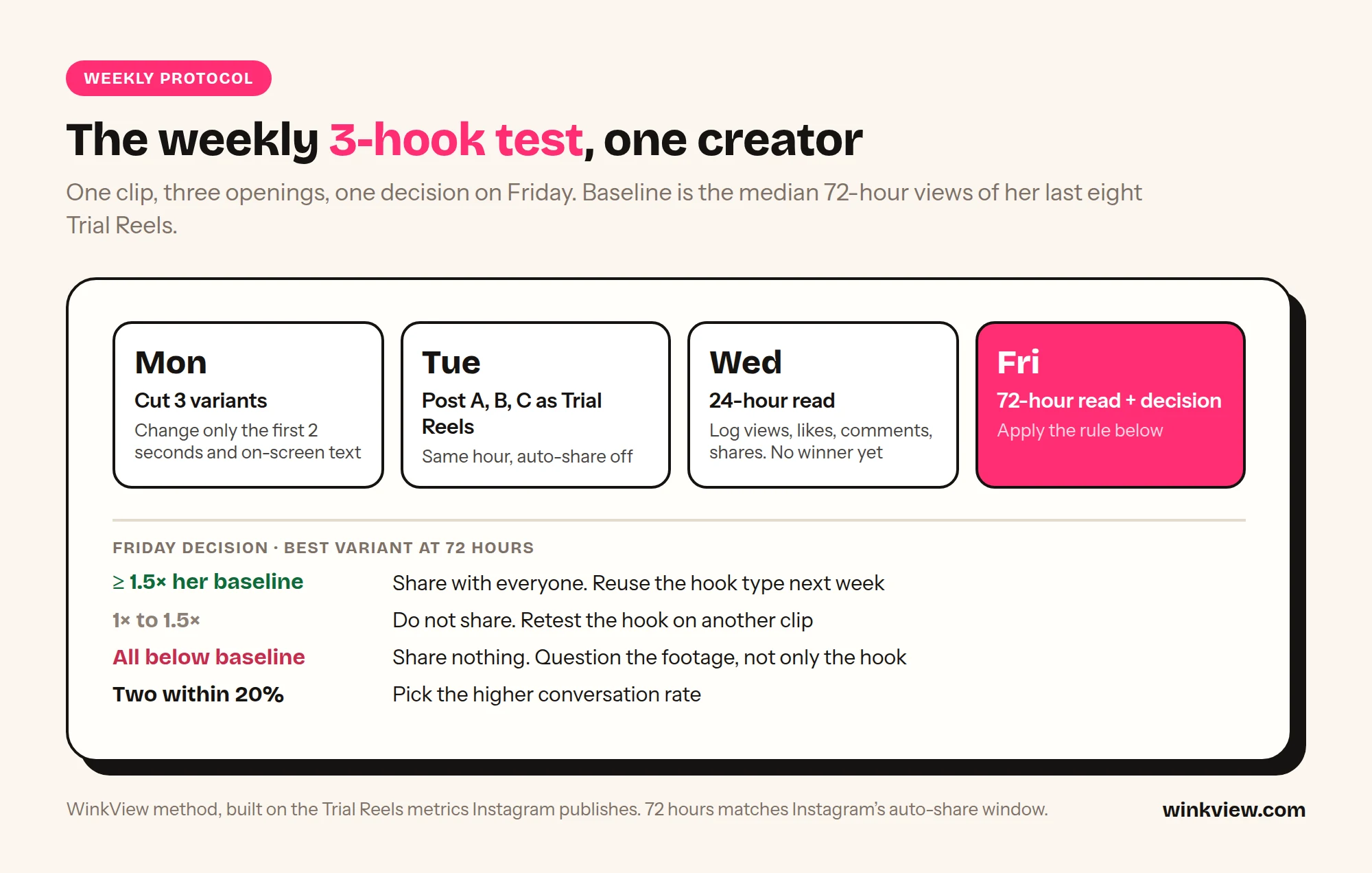
Monday: cut three variants. Take one finished clip. Change only the first two seconds and the on-screen text, so you have variants A, B and C. Keep the audio, length and body of the clip identical. If you also change the caption, change it in only one variant and note it, or you will not know which change worked.
Tuesday: post all three as Trial Reels, within the same hour, with auto-share off. Same day and hour means the three variants compete for similar audiences. To pick the hour, use the free best time to post Reels checker.
Wednesday: 24-hour read. Log views, likes, comments and shares. Do not pick a winner yet: early numbers swing.
Friday: 72-hour read and decision. Log the same four numbers again, then apply the rule below. 72 hours matches the window Instagram itself uses for auto-share.
Two derived numbers make the variants comparable:
- Baseline: the median 72-hour views of her last eight Trial Reels. Instagram’s own comparison with previous trials shows you roughly the same thing.
- Conversation rate: (comments + shares) per 1,000 views. Shares and comments take more effort than a like, so they are the better sign that the hook made someone care.
| 72-hour result for the best variant | What you do |
|---|---|
| Views at least 1.5x her baseline | Share it with everyone. Reuse that hook type on next week’s clip. |
| Views between 1x and 1.5x baseline | Do not share. Keep the hook for a retest on a different clip. |
| Views below baseline on all three | Share nothing. Retire the clip and question the footage, not only the hook. |
| Two variants within 20% of each other on views | Pick the one with the higher conversation rate. |
Why 1.5x: a variant that only matches her usual trial does not need a slot in her followers’ feed. The threshold is our starting rule; tighten it once you have a few months of logs.
Share the winning trial itself with “share with everyone” rather than uploading the clip again, so her grid does not end up with a duplicate and you stay clear of Instagram’s reupload guidance.
What to test for OnlyFans traffic
Test the parts of the clip that decide whether a stranger stops scrolling and then visits the profile. One variable per week.
Hook types (first 2 seconds)
- Start mid-action, no text
- A question on screen (“Which one for Friday?”)
- A POV line that sets a situation
- A reveal: before shown first, after held back
- Direct to camera, first word spoken in second one
On-screen text and CTA
- Text length: 3 words against 8 words
- Text position: top third against centre
- CTA: none, “more on my page” or “link in bio”
- CTA timing: in the first seconds or the last
- Pinned comment against no pinned comment
Keep every CTA inside Meta’s Community Standards, which apply to Instagram, including the rules on adult sexual solicitation. The safe pattern is to point to the profile, not to the paid platform: “more on my page” or “the rest is linked in my bio”. Do not name the paid site, do not use sexual wording and do not ask people to message for content. A Trial Reel that gets removed teaches you nothing, and removals show up in the account’s standing.
The bio link is where the test pays off. If a winning hook brings profile visits but the link gets few clicks, fix the bio and the pinned posts; the Instagram profile makeover for OnlyFans creators covers that step.
Worked example and weekly test log
Worked example (fictional, illustrative numbers)
Example: “Mila”, a fictional creator with a public professional Instagram account and the Trial toggle available. Her median 72-hour trial views over the last eight Trial Reels are 5,000. All numbers below are made up to show the maths, not real results.
The clip: a 12-second outfit change in a mirror. Three variants posted Tuesday at 19:00 her time, auto-share off.
- A, question text “Which one for Friday?”: 72-hour views 4,200; 22 comments, 18 shares. Conversation rate (22 + 18) / 4.2 = 9.5 per 1,000.
- B, starts mid-change, no text for 1 second: 24-hour views 6,900; 72-hour views 11,800; 35 comments, 61 shares. Conversation rate 96 / 11.8 = 8.1 per 1,000.
- C, POV text line: 72-hour views 3,100; 9 comments, 6 shares. Conversation rate 15 / 3.1 = 4.8 per 1,000.
B’s views are 11,800 / 5,000 = 2.36x her baseline, above the 1.5x line, so the team shares B with everyone on Friday. A lost on views but had the best conversation rate, so next week’s test puts A’s question text on top of B’s mid-action opening. C’s POV hook gets retired for Mila.
Log every test in one place per creator. After a month you have a record of which hook types work for her.
Copy this template
WEEKLY TRIAL REELS TEST LOG
Creator: [name]           Week of: [date]
Trial toggle available: [yes / no]
Baseline (median 72h views, last 8 trials): [ ]
Clip: [file name, length]
Variable tested this week: [hook / on-screen text / CTA / caption]

VARIANT A   Hook: [describe first 2 seconds]
  Text: [ ]              CTA: [ ]
  24h: views [ ] likes [ ] comments [ ] shares [ ]
  72h: views [ ] likes [ ] comments [ ] shares [ ]
  Conversation rate (comments+shares per 1,000 views): [ ]

VARIANT B   Hook: [ ]
  Text: [ ]              CTA: [ ]
  24h: views [ ] likes [ ] comments [ ] shares [ ]
  72h: views [ ] likes [ ] comments [ ] shares [ ]
  Conversation rate: [ ]

VARIANT C   Hook: [ ]
  Text: [ ]              CTA: [ ]
  24h: views [ ] likes [ ] comments [ ] shares [ ]
  72h: views [ ] likes [ ] comments [ ] shares [ ]
  Conversation rate: [ ]

DECISION (Friday)
Best variant: [A/B/C]   Views vs baseline: [ ]x
Rule applied: [share / retest / retire]
Shared with everyone: [yes / no]
Lesson for next week: [one line]
Next week's test: [variable + variants]
To fit the test into the rest of her week, slot the three Trial Reels into the Tuesday row of your weekly OnlyFans content calendar and keep the Friday decision in the weekly review.
Common Trial Reels mistakes
- Leaving auto-share on during a hook test. If two of three variants do well, Instagram can share both, and her followers get the same clip twice. Keep auto-share for single trials, not variant tests.
- Changing several things at once. New hook, new audio and a new caption on one variant means you cannot say which change won.
- Judging at 24 hours. The 24-hour number is a first read. Decide at 72 hours, the same window Instagram uses.
- Comparing against another creator. A 5,000-view trial is poor for one creator and great for another. Always compare against her own baseline.
- Treating trials as invisible. Followers can still reach a trial through a DM or an audio, location or filter page. Post nothing as a trial that you would not want a follower to see.
- Testing clips that will not be recommended. If all three variants stall, the clip is likely the problem. Change the footage before you blame the hook.
- Posting a winner once and never again. The best clip of the month deserves another run in front of people who missed it, spaced out and not every week.
- Forgetting the paid page. A winning hook sends visitors to the bio link; if the page behind it is weak, the test only proves you can get clicks. See why views are not turning into subscribers.
- Leaving the comments and DMs unanswered. A winning trial brings strangers who comment and message. Plan who answers them; Instagram DM automation for OnlyFans compares the options.
Platform rules
Trial Reels only reach people if Instagram is willing to recommend them. Keep clips safe for work: no nudity, no see-through clothing, no explicit wording in captions. Check the creator’s Account Status in Instagram settings, which shows whether her content is eligible for recommendation. Posting through the official connection keeps the publishing side inside Instagram’s rules, but Instagram still judges every clip.
Trial Reels automation for several creators
For one creator, the protocol above is a small weekly job. For ten, cutting variants, posting at the right hour in each time zone, flipping the Trial toggle every day and remembering which clip deserves a second run becomes a part-time job. Trial Reels themselves cost nothing, so the cost that matters is team time and any tool you use to post. Trial Reels automation means her clips are shown to non-followers every day without anyone on your team tapping the toggle.
WinkView’s Reposting Agent does this as part of each creator’s daily schedule, alongside her Instagram Reels, one Story a day, TikTok, YouTube Shorts, Facebook Reels, Threads and X. It posts through Instagram’s official posting API. Accounts connect through the official connect screens, and WinkView never sees or stores passwords.
- Fill her library. Your team uploads her clips once, finished or raw; raw ones go through the WinkView Video Editor first. WinkView does not film.
- Connect her accounts through each platform’s official connection.
- Posting runs daily. On a typical schedule of about 3 videos a day, 1 or 2 go out as Trial Reels and the rest as normal Reels, with AI-written captions for each platform, in her language and voice (EN, DE, SL, HR, SR or NO).
- Best performers get a second run. Now and then, clips that did well are reposted as new Trial Reels, so a clip that already worked reaches people who do not follow her yet.
- You check the numbers, not the toggle. The dashboard shows views, engagement, average views per post, followers gained and posts published or failed, plus “What WinkView sees”: best clip against typical, strongest platform, clips worth reposting and accounts needing reconnection.
Approvals are optional, and every post is logged in the posting history.
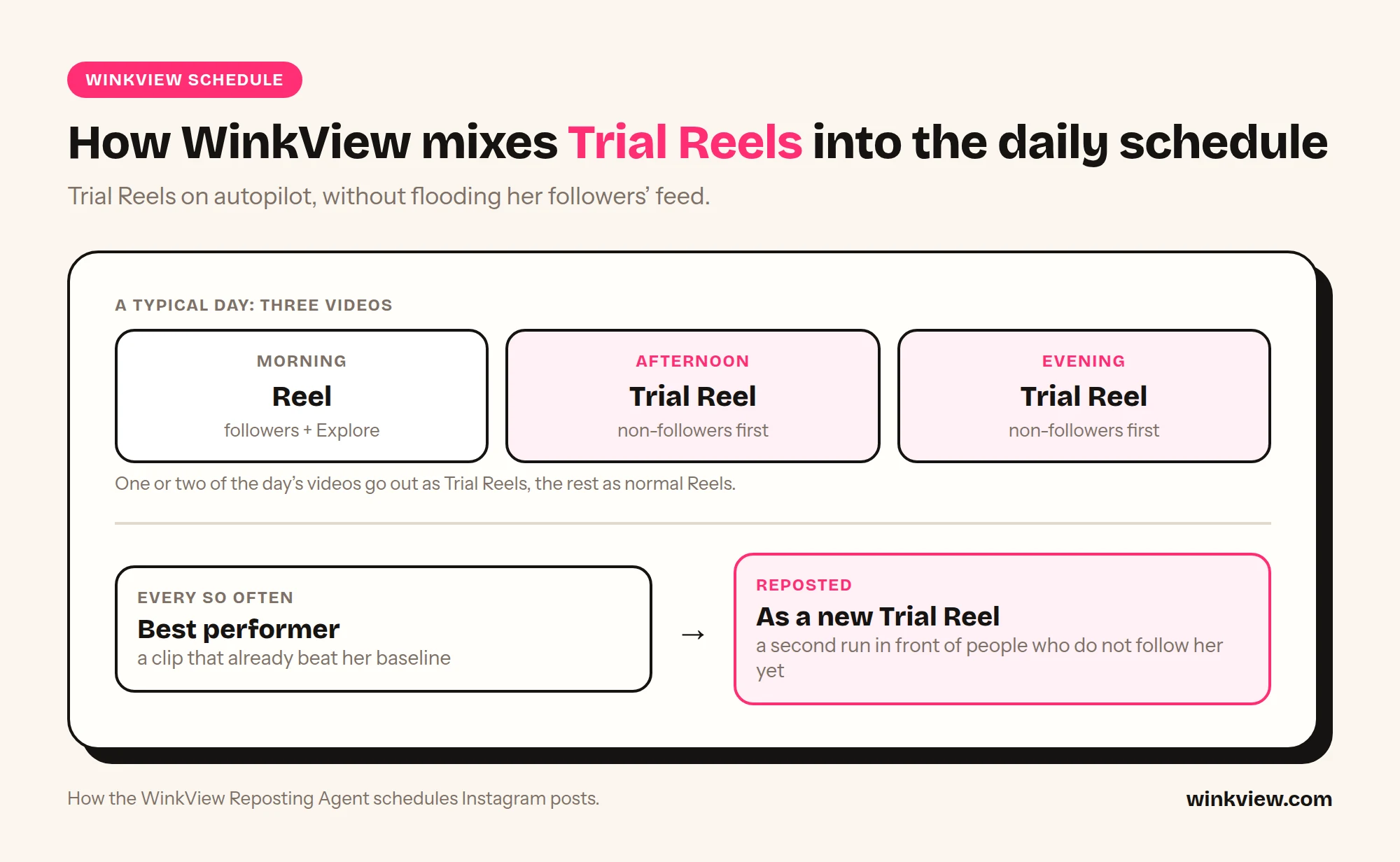
Why not post every clip as a Trial Reel? Because followers matter too. Normal Reels keep a creator in front of the people who already like her, and those people are closer to subscribing. Trials find new people. A mix of 1 or 2 trials a day does both jobs, and reposting strong clips as trials now and then, not every clip and not every week, gives them extra reach without spending new footage or running into Instagram’s reupload guidance.
Worked example: an automated week
Fictional creator, illustrative numbers. Lena is a fitness creator with 40 finished clips in her library: gym tips, outfit checks, a few funny outtakes. WinkView posts about 3 videos a day to her Instagram.
- Monday to Sunday: 21 videos go out. 11 are Trial Reels, 10 are normal Reels. Nobody at the agency opens Instagram to post.
- Thursday: the manager opens the dashboard. An outtake from Tuesday is her best clip of the week at roughly 9,000 views, against a typical clip of about 2,000.
- The following week: that outtake goes out again as a Trial Reel and reaches another round of non-followers. The manager asks Lena to film two more outtakes in the same style.
- Team time: about 15 minutes.
Real numbers come from our first customer, the agency WinkView was built for, run by a close friend of the founder. In 12 days across 15 accounts: 440,000 views, 238 of 241 posts published, about 2,000 average views per post. Instagram averaged about 4,300 per post, 6.2 times TikTok. That is one agency, not a promise. The full case study shows how it was set up.
Running the 3-hook test alongside automation
Because WinkView writes the captions, put your test variable into the clip itself (the first two seconds and the on-screen text) and upload A, B and C as separate clips. Open each trial in the Instagram app and check its share setting is what your test needs (Instagram lets you change it after posting). Read the results in Instagram’s own trial insights, then share the winner from the app. The daily schedule keeps her reach steady; the weekly test tells you which hooks to ask her to film next.
WinkView does
- Posts 1 or 2 Trial Reels a day per creator on a typical 3 a day schedule
- Posts the rest as normal Reels, plus one Story a day
- Reposts best performers as Trial Reels now and then
- AI-written captions for each platform, in her language and voice
- Posts through Instagram’s official connection, unlimited posts
- Shows what worked in one dashboard for every creator
WinkView does not
- Film clips for her
- Make an account eligible for Trial Reels if Instagram has not
- Guarantee that any trial reaches a set number of people
- Rescue clips Instagram will not recommend
- Post to OnlyFans, Fansly or Fanvue, or touch Reddit or Telegram
| Creators | WinkView plan | Per month (excl. VAT) | Per creator |
|---|---|---|---|
| 1 | Solo | €39 | €39.00 |
| 3 | Starter | €99 | €33.00 |
| 5 | Growth (6 places) | €189 | €37.80 used (€31.50 if all 6 places filled) |
| 10 | Pro | €279 | €27.90 |
The maths: €189 / 5 creators = €37.80 each while one place is empty. More than 10 creators: contact us. Every plan includes unlimited posts, the Video Editor and Reposting, and starts with a 7-day free trial (card required, nothing charged until day 8). See pricing for what each plan includes, or read about the Reposting Agent.
Where WinkView is not the right fit. If you want to hand-write every caption, or need all three test variants out in the same hour, post the test trials by hand in the Instagram app for that creator; an automated daily schedule is built for steady output, not for timing a test. Manual posting also costs nothing if you run one or two creators, like picking each trial by hand and have the time. WinkView saves time on daily posting across many creators and platforms; it does not replace reading the numbers and making the call on Friday.
Who runs it
WinkView runs the social side for agencies such as Nyvia, at about €30,000 a month, and Estrella, at about €40,000 a month, as well as the agency behind our 440,000-view case study.
Frequently asked questions
Do Trial Reels show up on the creator’s profile?
Not on the grid or the Reels tab unless you share them. Instagram keeps them in her profile next to drafts, and only she, or whoever runs the account, sees the trial label. Followers can still find a trial through a DM or an audio, location or filter page, so never post anything as a trial that followers should not see. A weak trial is therefore not sitting on her profile for fans to judge.
Why can’t I find the Trial toggle?
The account is not eligible yet. Instagram’s announcement limits Trial Reels to eligible creators without listing the criteria, and trade press reported in 2025 that access requires a public professional account with at least 1,000 followers. We could not confirm that bar on an Instagram page, so check the account type, make it public and look again as it grows. No scheduling tool can switch the feature on for an account Instagram has not made eligible.
Should I use auto-share or share manually?
For a single trial, auto-share is fine: Instagram shares it with followers if views in the first 72 hours look good. For a test with several variants of the same clip, share manually, or followers may see two versions of one clip. Manual sharing also lets you apply your own threshold against her baseline, such as the 1.5x rule in our weekly protocol, instead of relying on Instagram’s own judgement.
Can Instagram Trial Reels be posted automatically?
Yes. Meta’s official publishing API includes a trial setting for Reels, with manual or performance-based sharing, so approved software can post a trial without anyone tapping the toggle. WinkView’s Reposting Agent posts 1 or 2 Trial Reels a day per creator on a typical schedule of about 3 videos, plus reposts of her best performers now and then. The account still has to be eligible, and Instagram still decides whether each clip is recommended.
Can a Trial Reel and a normal Reel use the same clip?
Technically yes, but be careful. Instagram’s recommendation tips say “Avoid reuploading reels that are already on Instagram”, so the same clip posted again can lose reach with non-followers. That is why a strong clip should get a second run only now and then, not every clip and not every week. If a repost clearly does worse than the original, stop reposting it and ask the creator to film a new take in the same style.
Can I mention OnlyFans in a Trial Reel?
Trial Reels follow the same Community Standards as every other reel, including the rules on adult sexual solicitation, and they depend on recommendations, which exclude suggestive content. Our approach is to point to the profile, with lines like “more on my page” or “link in bio”, rather than naming the paid site or using sexual wording. A removed reel gives you no usable data and can hurt the account’s standing.